pyts.classification.BOSSVS
-
class
pyts.classification.BOSSVS(word_size=4, n_bins=4, window_size=10, window_step=1, anova=False, drop_sum=False, norm_mean=False, norm_std=False, strategy='quantile', alphabet=None, numerosity_reduction=True, use_idf=True, smooth_idf=False, sublinear_tf=True)[来源]¶ 向量空间中的SFA符号袋。
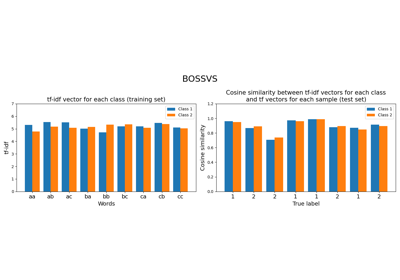
每个时间序列通过Bag-of-SFA Symbols (BOSS)算法转换为直方图。然后,针对每个类别,将这些直方图相加并计算tf-idf向量。对于新样本的预测类别,是其tf向量与每个类别的tf-idf向量之间余弦相似度最高的类别。
Parameters: - word_size : int (default = 4)
每个单词的大小。
- n_bins : int (default = 4)
要生成的区间数量。该值必须在2到26之间。
- window_size : int or float (default = 10)
滑动窗口的大小。如果是浮点数,表示每个时间序列大小的百分比,必须在0到1之间。窗口大小将计算为
ceil(window_size * n_timestamps)。- window_step : int or float (default = 1)
滑动窗口的步长。如果是浮点数,表示每个时间序列大小的百分比,必须在0到1之间。窗口大小将计算为
ceil(window_step * n_timestamps)。- anova : bool (default = False)
如果为True,则通过单向ANOVA检验选择傅里叶系数。如果为False,则选择前几个傅里叶系数。
- drop_sum : bool (default = False)
如果为True,则丢弃第一个傅里叶系数(即子序列之和)。否则,保留该系数。
- norm_mean : bool (default = False)
如果为True,在缩放前对每个子序列进行居中处理。
- norm_std : bool (default = False)
如果为True,将每个子序列缩放为单位方差。
- strategy : str (default = ‘quantile’)
用于定义分箱宽度的策略:
- ‘uniform’: 每个样本中的所有箱宽度相同
- 'quantile': 每个样本中的所有分箱具有相同数量的数据点
- ‘normal’: 箱边缘为标准正态分布的分位数
- ‘entropy’: 使用信息增益计算分箱边界
- alphabet : None, ‘ordinal’ or array-like, shape = (n_bins,)
使用的字母表。如果为None,则使用拉丁字母表的前n_bins个字母。
- numerosity_reduction : bool (default = True)
如果为True,则删除样本中除一个之外的所有连续出现的相同单词。
- use_idf : bool (default = True)
启用逆文档频率重新加权。
- smooth_idf : bool (default = False)
通过向文档频率加一来平滑idf权重,就像假设有一个额外的文档包含了集合中的每个术语恰好一次。这样可以防止除零错误。
- sublinear_tf : bool (default = True)
应用次线性词频缩放,即用1 + log(tf)替换tf。
参考文献
[1] P. Schäfer, "可扩展的时间序列分类". 数据挖掘与知识发现, 30(5), 1273-1298 (2016). 示例
>>> from pyts.classification import BOSSVS
>>> from pyts.datasets import load_gunpoint
>>> X_train, X_test, y_train, y_test = load_gunpoint(return_X_y=True)
>>> clf = BOSSVS(window_size=28)
>>> clf.fit(X_train, y_train)
BOSSVS(...)
>>> clf.score(X_test, y_test)
0.98
Attributes: - classes_ : array, shape = (n_classes,)
分类器已知的类别标签数组。
- idf_ : array, shape = (n_features,) , or None
当
use_idf=True时学习到的idf向量(全局词权重),否则为None。- tfidf_ : array, shape = (n_classes, n_words)
词项-文档矩阵。
- vocabulary_ : dict
特征索引到术语的映射。
方法
__init__([word_size, n_bins, window_size, …])Initialize self. decision_function(X)Evaluate the cosine similarity between document-term matrix and X. fit(X, y)Compute the document-term matrix. get_params([deep])Get parameters for this estimator. predict(X)Predict the class labels for the provided data. score(X, y[, sample_weight])Return the mean accuracy on the given test data and labels. set_params(**params)Set the parameters of this estimator. -
__init__(word_size=4, n_bins=4, window_size=10, window_step=1, anova=False, drop_sum=False, norm_mean=False, norm_std=False, strategy='quantile', alphabet=None, numerosity_reduction=True, use_idf=True, smooth_idf=False, sublinear_tf=True)[来源]¶ 初始化自身。查看 help(type(self)) 获取准确的签名信息。
-
decision_function(X)[来源]¶ 评估文档-词项矩阵与X之间的余弦相似度。
参数: - X : array-like, shape (n_samples, n_timestamps)
测试样本。
返回值: - X : 数组, 形状 (n_samples, n_classes)
文档-词项矩阵与X之间的余弦相似度。
-
fit(X, y)[来源]¶ 计算文档-词项矩阵。
参数: - X : array-like, shape = (n_samples, n_timestamps)
训练向量。
- y : array-like, shape = (n_samples,)
每个数据样本的类别标签。
返回值: - self : object
-
get_params(deep=True)¶ 获取此估计器的参数。
参数: - deep : bool, default=True
如果为True,将返回此估计器及其包含的子估计器的参数。
返回值: - params : dict
参数名称映射到对应的值。
-
predict(X)[来源]¶ 预测所提供数据的类别标签。
参数: - X : array-like, shape = (n_samples, n_timestamps)
测试样本。
返回值: - y_pred : array, shape = (n_samples,)
每个数据样本的类别标签。
-
score(X, y, sample_weight=None)¶ 返回给定测试数据和标签的平均准确率。
参数: - X : array-like, shape = (n_samples, n_timestamps)
单变量时间序列。
- y : array-like, shape = (n_samples,)
X的真实标签。
- sample_weight : None or array-like, shape = (n_samples,) (default = None)
样本权重。
Returns: - score : float
self.predict(X)关于 y 的平均准确率。