pyts.preprocessing.PowerTransformer
-
class
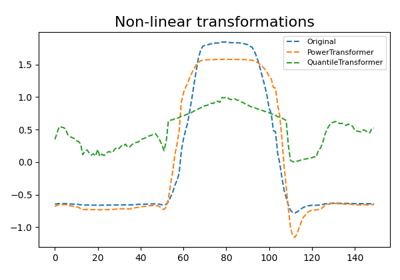
pyts.preprocessing.PowerTransformer(method='yeo-johnson', standardize=True)[来源]¶ 对样本进行幂变换,使数据更接近高斯分布。
幂变换是一系列参数化、单调的转换方法,用于使数据更接近高斯分布。这对于处理与异方差性(非常数方差)相关的建模问题非常有用,或在其他需要正态性的场景中也很有帮助。
目前,PowerTransformer支持Box-Cox变换和Yeo-Johnson变换。通过最大似然估计来估计稳定方差和最小化偏度的最佳参数。
Box-Cox变换要求输入数据必须严格为正数,而Yeo-Johnson变换同时支持正数和负数数据。
默认情况下,对转换后的数据应用零均值、单位方差的归一化处理。
参数: 注意事项
NaN值被视为缺失值:在
fit中被忽略,并在transform中保留。参考文献
[1] I.K. Yeo 和 R.A. Johnson, "一种新的幂变换家族用于改进正态性或对称性。" Biometrika, 87(4), pp.954-959, (2000). [2] G.E.P. Box 和 D.R. Cox,《转换分析》,英国皇家统计学会期刊B辑,26卷,211-252页(1964年)。 示例
>>> import numpy as np
>>> from pyts.preprocessing import PowerTransformer
>>> X = [[1, 3, 4], [2, 2, 5]]
>>> pt = PowerTransformer()
>>> print(pt.transform(X))
[[-1.316...  0.209...  1.106...]
 [-0.707... -0.707...  1.414...]]
方法
__init__([method, standardize])Initialize self. fit([X, y])Pass. fit_transform(X[, y])Fit to data, then transform it. get_params([deep])Get parameters for this estimator. set_params(**params)Set the parameters of this estimator. transform(X)Transform the data. -
fit_transform(X, y=None, **fit_params)¶ 拟合数据,然后进行转换。
使用可选参数fit_params将转换器适配到X和y,并返回转换后的X版本。
参数: - X : array-like, shape = (n_samples, n_timestamps)
单变量时间序列。
- y : None or array-like, shape = (n_samples,) (default = None)
目标值(无监督转换时为None)。
- **fit_params : dict
额外的拟合参数。
返回值: - X_new : array
转换后的数组。
-
get_params(deep=True)¶ 获取此估计器的参数。
参数: - deep : bool, default=True
如果为True,将返回此估计器及其包含的子估计器的参数。
返回值: - params : dict
参数名称映射到对应的值。
-